
Road Trip Diaries · Day 2
Las Vegas, Easter, Year of our Lord 2026 · A two-mile walk down the Strip, a gondola powered by a foot pedal, and the eviction of a small geological resident

Written by Tim · Stevie's other half
Off The Map Jewellery family road trip · Easter 2026
Watch the Chaos ▸ Day 2 Short
The morning announced itself with the cruelty of a desert city that has no interest in your sleeping patterns. The air conditioning had conducted its loud, ineffective campaign through the night and lost. We were awake.
The plan, loosely conceived, was to head to Caesars and find a gluten-free waffle for breakfast.
But first we wanted to look at the water park.
Circus Circus has a water park — the Splash Zone — visible through the windows on the lower floors, all flumes and drops and the bright primary colours of engineered fun. We had packed our swimmers among many, many other things. The flumes were the question, the spectacle behind the glass that needed verifying before committing to it. We took the elevators down — the elevators, always the elevators — and went to look.
TEMPORARILY CLOSED

This is what Vegas does. It offers you the idea of a thing and then shows you the thing not working. Touchscreens that cannot find your booking. Elevators that do not stop at your floor. Stairs that end in concrete. A water park closed for maintenance in a desert resort at peak Easter holiday season.
At some point this stops being a series of failures and becomes a statement of intent.
This is what Vegas does. It offers you the idea of a thing and then shows you the thing not working. A water park closed for maintenance in a desert resort at peak Easter holiday season.
There really is a pool at Circus Circus, an actual pool that guests can use. But the flumes were another matter. Right now they were sitting dry and coned-off in the morning sun.
We went back inside and waited for Edd and Genea in the lobby.
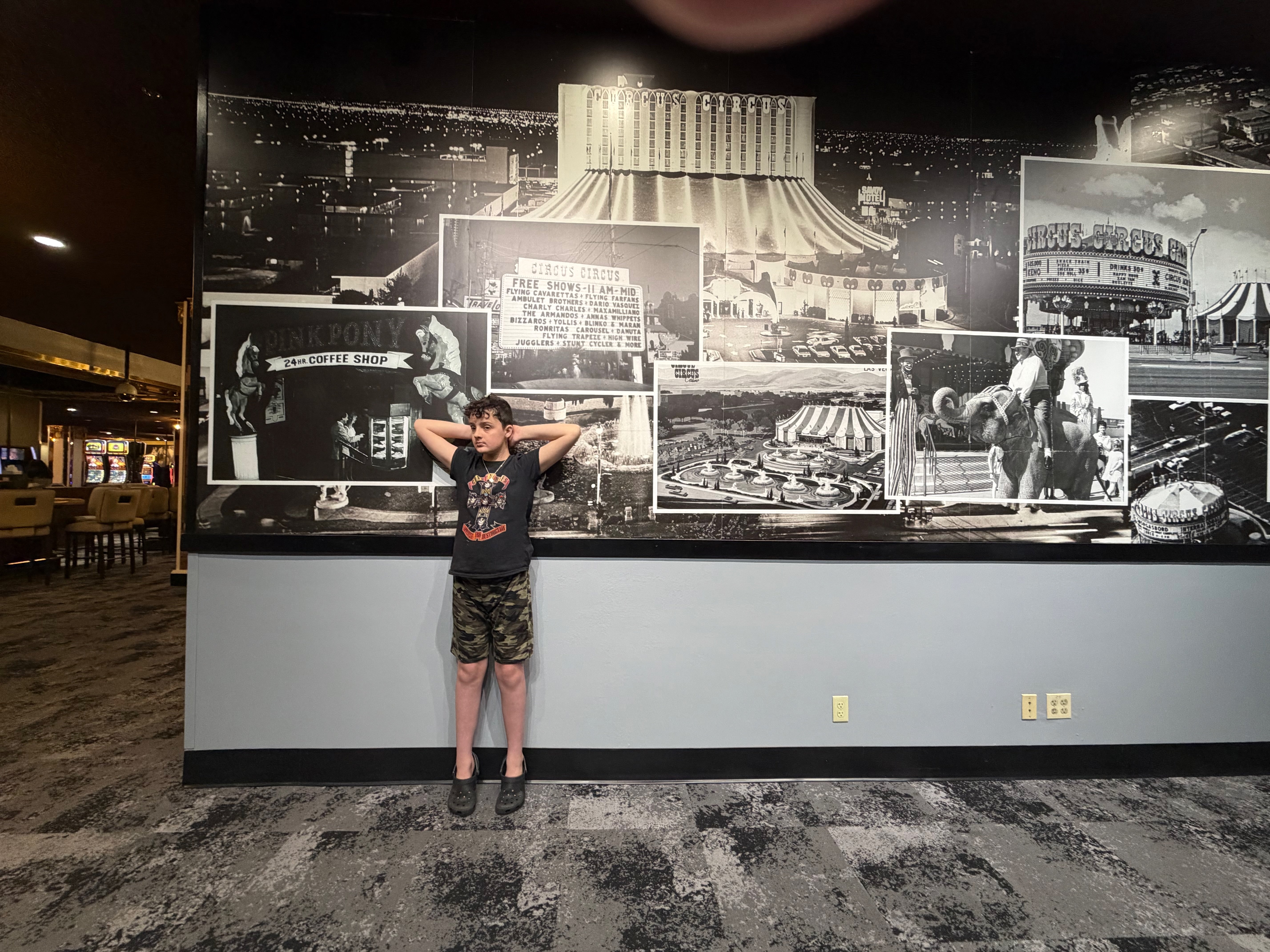
I looked at the photographs on the wall.
Circus Circus has lined its walls with large black and white prints from its own history — the 1960s and 70s, when the place was new and genuinely, structurally deranged in the best possible way. A man outside the hotel, on what appears to be Las Vegas Boulevard, riding an elephant — the animal enormous and calm, indifferent to everything, as elephants are. A kangaroo in boxing gloves, the referee standing behind him, and the kangaroo looking not triumphant but oddly melancholy, as though he has understood something about the situation that the referee has not, or simply wanted to be free to bounce around the Australian outback like his parents.
Clowns on stilts moving through crowds dressed with that particular density of pattern and optimism that only the late 60s could produce.
You look at these photographs and understand that Circus Circus was, at its peak, not deranged as a theme or a brand position but deranged as an actual operating condition. And you think, as you always think looking at photographs from 50 years ago, that everyone in them is almost certainly dead. The indifferent elephant. The sad kangaroo. The clowns on their stilts. The crowds in their patterns. All of them gone now, and only the building remaining, with its broken terminals and its clown-faced columns, still open for business.
You look at these photographs and understand that Circus Circus was, at its peak, not deranged as a theme or a brand position but deranged as an actual operating condition.
We decided to walk to Caesars Palace.
The first thing we saw, stepping out and heading south, was a man shouting at the traffic. Not at any particular vehicle — at the traffic in general, at the continuous flow of it, at whatever argument he was having with the road or the city or something further inside himself that the road and the city had come to represent. He shouted. The traffic passed.
Two miles. On paper this is nothing. In the heat of Las Vegas it is a serious proposition.
The Strip is not built to human scale. It is built to the scale of a fever dream about cars — a city designed by people who believed that legs were a transitional technology, that the pedestrian was a problem to be solved rather than a person to be accommodated. The crossing structures take you up three floors and back down again to move you across a road that could be crossed in 15 seconds if the road were willing. The distances that the eye compresses, the body then disputes at length.
The Strip is not built to human scale. It is built to the scale of a fever dream about cars — a city designed by people who believed that legs were a transitional technology.
We stopped at the CVS store inside Treasure Island on the way. This required passing through the casino, which is the price of everything in Las Vegas — you pass through the casino to get to the pharmacy, to the restaurant, to the exit. The casino is the connective tissue of the city and there is no navigating around it.
I needed Phenazopyridine. AZO — the urinary analgesic, the thing that calms the internal situation and turns everything downstream a colour that has no business appearing in a toilet bowl. I asked a woman who worked there. She led me with cheerful efficiency to a section of the aisle that was, entirely and without exception, devoted to the management of female urinary complaints. I thanked her and found, slightly further along, a generic version in packaging that made no assumptions about my anatomy. I paid with cash. The change left me with a small amount of coin that mattered shortly afterwards.

She led me with cheerful efficiency to a section of the aisle that was, entirely and without exception, devoted to the management of female urinary complaints.
And it was hot. Ten in the morning and already the desert was making its case.
I walked with the careful gait of a man whose interior geography is still in active dispute, every patch of shade a minor victory. Seven people moving south through the heat, looking for breakfast.
Before Caesars, Trump Tower.
It stands slightly apart from everything else — not part of the Strip's continuous theatre of themed excess but separate from it, aloof, a tall column of gold glass that has the quality of something that arrived without consulting the neighbours and has no intention of explaining itself. You feel its surface before you see it properly. Where every other building on the Strip absorbs the desert and gives it back as warm exhaust at street level, this one does the opposite — it throws the heat back, refuses to take it in, the gold reflecting away the morning the way a mirror reflects a face. Cool to walk past. The other buildings sweat. This one does not.
The gold is real, incidentally — 24-karat, sputtered onto an interior surface of the insulated glass specifically to reflect the desert heat, which makes it the only building on the Strip that is being honest about what it is made of. It was built in partnership with the same man who owns Circus Circus, which means he is simultaneously presiding over the tackiest hotel in Las Vegas and the most aloof one, and apparently sees no contradiction in this.
There was supposed to be a second tower — it sold out almost immediately and a twin was planned. The 2008 recession collapsed it. The gap where the companion should have been is now a car park behind the Fashion Show Mall.
Just past it, an enormous guitar came into view.
Not a finished guitar — a guitar under construction. Forty-two storeys of blue-glass tower rising from the site of the old Mirage, and beside it the Mirage itself still standing, gutted, its famous interior stripped back to concrete bones, being reborn inside its own skeleton.
The Mirage closed in July 2024 after 34 years, its volcano erupting on schedule to the last, and now the Hard Rock guitar tower is going up in its place. The Seminole Tribe of Florida, which owns Hard Rock International, are spending somewhere between four and five billion dollars on this — 660 feet when complete, the third-tallest building on the Strip, shaped like a guitar because someone in a boardroom asked what to build on one of the most valuable pieces of land in America and the answer that came back was: a guitar.

Caesars Palace arrives the way all large things arrive — gradually and then all at once. You have been walking toward it for what seems like long enough and then suddenly you are inside the Forum Shops.
The Forum Shops are built to resemble a Roman street — a shopping mall in which the ceiling has been painted to look like a sky and the shops are set into what appear to be the facades of ancient buildings. The painted sky is always a pleasant afternoon. It does not vary. In Caesars Palace, weather is a design decision and the decision is that it will always be a pleasant afternoon in Rome. This is not irony. This is the point.
The original plan had involved Dominique Ansel — the James Beard Award-winning pastry chef whose Caesars outpost is small, jewel-like, and primarily a pastry operation. However beautiful, this seemed to me insufficient.
I led the party to Café Americano. Stevie allowed this.
Café Americano is just off the main lobby of Caesars Palace — 24 hours, large, well-lit, American comfort food with a Latin twist, the menu the size of a small novel. The prices reflect with quiet honesty the fact that you are sitting just off the main lobby of Caesars Palace on a Saturday at Easter.
We did not sit immediately. At the door, the question of gluten-free buttermilk pancakes was raised with the maître d', who closed the file on it with the gentle efficiency of someone who has been doing this for years. He spoke to Edd's daughter — Edd explained her allergy to the capsicum family, gluten, the whole complex brief — and the maître d' talked her through what the kitchen could actually do. Which was a proper American breakfast: very crispy bacon, eggs fried hard and definite, no ambiguity about the yolk. She didn't know about over easy. America, left to its own devices, cooks eggs all the way through, and this was fine. We waited a few minutes for a table for seven.
While we waited, my daughter mentioned her blistered feet. Her Crocs had been doing their work on bare skin for the better part of two miles and the bill had come due. Edd produced a plaster from somewhere — from a pocket, from a bag, from the kind of man who simply has these things when they are needed — and Stevie applied it.
Then we sat, and the food came. I had a poké bowl. I called it a poke bowl when I ordered it, without the accent, and the waiter suppressed a smile. It was good but not quite enough. Stevie and Genea had salads. My daughter had pizza. Edd had a fish taco situation.
Genea and Edd's daughter ate everything: the crispy bacon, the decisive eggs, some gluten-free toast. She was content. In the management of a severe multi-ingredient allergy in America, a meal that arrives without incident and gets eaten entirely is not a small thing.
The bill was $250. More than we vaguely expected, less than it might have been, and we were on holiday, and that was that.

The Miracle Mile Shops at Planet Hollywood are a circular mall with a fake sky that runs, on some automated schedule, through simulated weather conditions including an indoor rainstorm. In Las Vegas the simulation of nature is considered an amenity while nature itself is considered a problem.
In Las Vegas the simulation of nature is considered an amenity while nature itself is considered a problem.
We came here for socks. My daughter's foot, freshly plastered, needed something between the Crocs and the skin for the walk back. The novelty sock shop had socks but not the right kind. H&M had the right kind for $10.
Then my son needed the facilities, and there was a quality to the announcement that suggested his condition was not entering a negotiation phase. I took him back into the Miracle Mile and we found the restrooms at the back — multiple stalls, most of them free.
He went in. I stepped up to the urinal.
What happened next was this. The kidney stone — or the fragment of it, the piece that the lithotripsy had left behind, that had been inside me for months and had ridden the transatlantic pressure change into action and had been conducting its slow hostile campaign through Las Vegas for two days — came out like a pellet from a potato gun. Small, hard, audible. The product of months of geological process, fired into the urinal of the Miracle Mile shopping mall with a velocity that suggested it had been waiting for exactly this moment and had strong views about the exit.
The irritation stopped. The way a sound stops, not gradually but completely, the silence arriving all at once.
I tried to retrieve it. The doctor had asked me to save a fragment for analysis, and I had come this far with the thing, and I wanted to see it — this object that had been inside me for months and had travelled transatlantic and had made its presence known at every inconvenient juncture since Thursday. I searched the urinal. I lifted the plastic splash guard. I put my fingers into the drain with the focused attention of a man who has decided that dignity is a resource to be deployed strategically and that this was not the moment for it.
It was gone. The Miracle Mile had taken it. Las Vegas, which takes everything eventually, had taken my kidney stone.
I washed my hands with great thoroughness. I walked back out past the fake sky and the indoor rainstorm and rejoined my family, lighter than I had left them. My son emerged shortly afterwards, similarly lightened, by more conventional means, his expression that of a boy who has successfully concluded a difficult piece of business.
Back on the Strip, heading toward the Linq, a man in orange robes was working the pavement. Under the hem, jeans. Beneath the jeans, trainers. The robes a costume rather than a vocation, though the question lingered — maybe he really was a Buddhist. Maybe he was a Buddhist who had also decided to sell bracelets, which is not theologically impossible. He was not visibly good at selling them. Nobody bought one while we watched. He moved close, maintained proximity, followed us for a while. He seemed not so much entrepreneurial as stranded, a man on the edge of something he hadn't quite fallen into yet, the orange robes holding the line between one version of his life and another.
We went into the Linq Promenade looking for slushies.
Las Vegas has no meaningful open container law, which means you can walk the Strip with alcohol in a plastic cup and nobody will stop you, which is why at any given moment a significant percentage of the pedestrian population is carrying something frozen and violently coloured in a yard-long tube. The slushie is a Las Vegas institution, sold the length of the Strip in flavours that gesture toward fruit — watermelon, mango, peach, pineapple, cherry, green apple — and achieve something more in the direction of a chemical approximation of fruit's general reputation. The alcohol in the adult versions is rum, typically 151-proof, with extra shots available for a few dollars more.
We found the daiquiri stand in the Linq Promenade and got a round. Adults with alcohol. The children with the non-alcoholic version, which was, if anything, more aggressively sweet.
Opposite, a magician was doing a magic show. We knew this because his sign said MAGIC SHOW. He had a small table, a deck of cards, and a tiny rubber rabbit that he caused to appear and disappear with the enthusiasm of a man who has performed this trick 10,000 times and has long since passed through wonder into professional neutrality. Mostly he looked at his phone. When he wasn't looking at his phone he flicked through cards.
Some people went into the shop behind him — he seemed to know them — and he watched them go in with the interest of someone whose actual job might be something other than actual magic.
The slushies drove everyone slightly insane. Not the alcohol: the colour. There is something in the dye, or the sugar, or the combination of both in that specific ratio, that acts on the system in a way that the quantity of alcohol does not fully explain. The children abandoned theirs halfway through, too sweet, too chemical, too much. The adults finished theirs with the commitment of people who have paid for something and intend to extract its full value regardless of what their bodies are telling them.
The slushies drove everyone slightly insane. Not the alcohol: the colour. There is something in the dye, or the sugar, or the combination of both in that specific ratio, that acts on the system.
We all got a mild headache.
We went into the Venetian.
The Venetian's indoor canal runs beneath a trompe-l'œil ceiling painted to look like a Venetian sky at dusk — perpetual, perfect, the clouds never moving. The gondoliers sing. They wear striped shirts and straw hats and they sing O Sole Mio and they mean it, or they perform meaning it, which in Las Vegas amounts to the same thing. What propels the gondolas, hidden beneath the fibreglass hulls, are small electric motors. The gondolier's oar steers. The motor moves. This is something the Venetian does not advertise and is confirmed by everyone who has looked into it, including former gondoliers and at least one president of the Gondola Society of America, who documented the foot pedals: one for forward, one for reverse.
The canal is two feet deep. The whole operation is an extraordinarily convincing performance of something that is not quite what it appears to be, which makes it the most Las Vegas thing in Las Vegas, which is saying something.
We watched a gondolier sing to a couple who appeared genuinely moved. The oar moved through the shallow water. The motor hummed somewhere underneath. The painted sky did not change. Nobody seemed to mind.
The oar moved through the shallow water. The motor hummed somewhere underneath. The painted sky did not change. Nobody seemed to mind.

On the way back north, we stopped at the CVS store in Treasure Island again — Stevie and Genea wanted rum for the evening. The spirits section is its own cordoned territory inside the store, a small kingdom of alcohol behind a low barrier you are not supposed to cross if you are under 21, supervised at a remove by staff who monitor rather than engage. The tannoy crackled with a request for assistance in the liquor area, the bureaucratic ceremony required before the rum could be released into civilian hands, because in America the purchase of alcohol requires this specific ritual and it coexists, apparently without irony, with the slot machines 20 feet away.
Near the pharmacy end of the store, a woman was moving through the aisles. She was extraordinarily dirty in the way that only living outside for a long time makes a person dirty — not the dirt of a day but the accumulated dirt of weeks or months, ground in, structural, part of her now. Her clothes were in the late stages of disintegration. She moved with her eyes slightly unfocused, not at the products but through them, at something further away or further inside. The fluorescent light of the CVS was not kind to her. Nobody on the staff moved toward her or away from her. She was simply there, in the aisles, in the light.
We left.
Outside, at the top of the footbridge, a man sat with one hand holding a sign, his face buried in the crook of his elbow. The sign said: Hungry, please help if you can. He was not looking at anyone. He had hidden his face entirely — from the sun, from the shame, from the weight of the ask. The sign said what it said from behind the shelter of his own arm.
I had given my change already — a dollar and a bit, to a man earlier outside the CVS who had said have a blessed day with the quiet sincerity of someone who means it. So I had nothing left. We walked on. The casino entrance behind the man played something bright into the street. The song did its job.
Outside the Encore, a Zoox pod glided through the crossing — the Amazon autonomous vehicle, sealed and steeringwheelless, navigating the intersection with the calm of a machine that has concluded that human uncertainty about traffic is an engineering problem.
My son watched it pass.
"I hate it," he said.
It is their world. They are allowed to hate it.
Between the Encore tower and the street, in the specific shadow a casino tower casts in the afternoon, the Guardian Angel Cathedral — a modernist A-frame from 1963, all conviction and angles, a building that made a simultaneous decision about God and architecture and has not reconsidered either. It sat in the Encore's shadow with the composure of something that has seen everything this particular block has done and revised none of its conclusions. On the steps a woman sat with a cardboard sign.
The Encore rose behind her. The music from the nearest entrance reached even here, faintly, like a rumour.
Heading back toward Circus Circus, the empty lots began — gaps in the Strip where the legendary names used to be and are no longer. The New Frontier imploded in 2007 and the land sitting empty since, 38 acres of prime Las Vegas Boulevard frontage that has been fenced-off dirt for nearly 20 years while the people who own it consider their options. In a city that tears down and rebuilds at speed, these voids are conspicuous — the Strip's missing teeth, waiting for money and nerve to coincide.
Opposite Circus Circus, the white towers of Turnberry Place rose 38 storeys — four of them, identical, guard-gated luxury condominiums where Joe Weider, the bodybuilding magnate who invented the modern fitness industry, ended up living. In the middle of the four towers sits the Stirling Club — 80,000 square feet of spa, tennis courts, fine dining, and a cigar room, accessible only to residents and members, a city within a city. Below the towers, on the sidewalk where the music plays from every bush, the tunnel access points are hidden in the scrubby ground cover, and the people who have nowhere else to go sit in the thin shade under the monorail track.
This end of the Strip is where the dream gets worn thin. Not gone — the action is still here, Resorts World and Fontainebleau have brought new money north, the guitar is going up — but more stretched, the tourist bubble less pressurised than it is down by Caesars and the Bellagio. The liminal quality of it is real. Above ground: a man in orange robes selling bracelets to nobody, a magician looking at his phone, a woman with a sign in the doorway of a cathedral. Twenty feet below: the tunnels, the flood channels, the people who have built a life in the infrastructure of a city that was not designed to accommodate them, who come up to the surface during the day and disappear below at night.
The music plays 24 hours. The towers look down. The gondolier's motor hums in the shallow water and the painted sky does not change.
The music plays 24 hours. Into the street, into the bushes, into the ears of anyone trying to sleep within range of the speakers.
The music plays 24 hours. Into the street, into the bushes, into the ears of anyone trying to sleep within range of the speakers.
Las Vegas has always had this. The dream and the people the dream has no use for, occupying the same geography, never quite seeing each other. What is different here, at the north end, is that the curtain is a little bit transparent. The set dressing is sparser. The gap between the penthouse and the flood channel is measurable in feet rather than the comfortable abstraction that the central Strip maintains between its aspirations and its realities.
We got back to Circus Circus.
The elevator was fine: not a queue, not an adventure, just an elevator doing what elevators do, which after two days at Circus Circus felt like a minor miracle.
But later, we needed to go out again for food.

To get to the cheap food joints near Circus Circus you have to cross the Strip. There is no elegant way to do this. The pedestrian bridges take you up and over with the inefficiency of infrastructure designed for a city that considers walking a last resort, but we were hungry and it was evening and we jaywalked instead — badly, moving across six lanes with the optimism of people who have made a decision and are now committed to it.
Nobody died. Las Vegas absorbs this kind of thing.
It has seen worse.
On the other side, a woman in a wheelchair sat at the kerb with a cup. Further along the block a man was trying to propel himself forward on what appeared to be a mobility scooter that had run out of battery — pushing it with one leg, his only leg, the dead machine requiring more effort to move than walking would have if walking had been available to him. The Strip traffic moved past him. The evening light was very bright.
Around the corner, a Pho restaurant. Authentic in the specific way that means the people running it are Vietnamese and the broth has been going since before you arrived. We went in with hope. The hope was that a Vietnamese noodle restaurant might have a vegetarian option, which is a reasonable thing to hope, except that this one was quite correctly operating on the principle that pho is beef and beef is pho and any other interpretation of the situation represents a misunderstanding on the part of the customer. Beef or nothing.
There was, however, a sandwich. A vegetarian sandwich. I ordered the sandwich with fries for myself and my son — a consolation, but a good one as it turned out. Proper bread, proper filling, constructed with care. We took it back to the hotel while Stevie, Edd and Genea went on to find something that worked for everyone else.
Miraculously the elevator lobby was once again not busy, and we ascended to the 14th floor without delay.
I sat on the bed and ate and looked at the room. The television. The lamps. The mirrors in their frames. The bedside tables, the desk, the wardrobe, the fittings in the bathroom I could see through the open door — the towel rail, the gel soap dispenser fixed to the wall delivering its measured squirt of something that smells approximately of lavender and approximately of nothing, the hairdryer holstered in its bracket with the faint scorched smell of 10,000 previous heads, the toilet with its scratched bowl. All of it dated, all of it functional, all of it maintained by the invisible army to a standard that the rest of the operation had conspicuously failed to match.
Three thousand seven hundred and sixty-seven rooms in this building, each one with the same television, the same lamps, the same toilet. Give or take. Multiplied out, that is an enormous quantity of furniture. An enormous quantity of fittings, fixtures, mattresses, bedframes, carpets, curtains.
And all of it, eventually, bound for a skip.
Three thousand seven hundred and sixty-seven rooms in this building, each one with the same television, the same lamps, the same toilet. And all of it, eventually, bound for a skip.
Circus Circus is for sale. Its owner, Phil Ruffin — 89 years old, billionaire, close friend of the current President of the United States — announced in January 2025 that he is looking to sell. He bought it from MGM in 2019 for $825 million. He now values it at five billion dollars. He is not selling it because the operation is struggling — it supposedly generates 90 million dollars a year in earnings before costs, and Ruffin is proud of the economics. "We sell two-dollar beer, two-dollar hot dogs, two-dollar popcorn," he told Forbes. "People love it. A guy can eat and drink for six bucks."
He is selling it because of the land. A hundred and two acres on the north Strip, 2,000 feet of Las Vegas Boulevard frontage. "It's the best piece of land on the West Coast," he said. "Why do you think I bought Circus Circus? For the 102 acres. That's the land play."
The land play. Not the elevators, not the carousel, not the photographs of the man on the elephant. The land. The building that sits on it — the towers, the Adventuredome, the Splash Zone that is closed for maintenance, the casino floor with its touchscreens, the stairwell that ends in concrete — all of this is, in the calculation of the man who owns it, essentially beside the point. What matters is what it stands on. And what it stands on is worth five billion dollars to whoever wants to build something new on the north Strip.
I finished the sandwich. My son, thwarted by the Circus Circus wifi — not strong enough to actually play Roblox, only strong enough to watch other people play Roblox on YouTube, which is its own particular circle of a child's hell — sat propped against the headboard watching tutorials for a game he could not access, the screen casting its blue light across the dated room. Outside, Stevie and Edd and Genea were still out somewhere, eating dosa served to them by a robot.
I turned off the lamp — one of 3,767 lamps — and lay in the dark on the 14th floor of Circus Circus as I had the night before, while my son watched someone else's Roblox.
Tomorrow we collect the hire cars. Two of them. Seven people: Stevie and me, Edd and Genea, and between us three children who have now survived Las Vegas, the terminals, the elevators, the dead end stairwell, the closed water slides and the Linq slushies — and will shortly be asked to absorb the Grand Canyon.
The desert, which had been endlessly patient with all of us, was about to become the point.
A note from Stevie
Day 2 of our family Las Vegas road trip, Easter 2026 — we'd love you to follow along for more dispatches from the road. In the meantime, if you'd like a piece of jewellery that travels as well as we do, you'll find us at offthemapjewellery.com.