Road Trip Diaries · Day 1
Las Vegas, Easter, Year of our Lord 2026 · 14 hours of travel, seven people, and a hotel that had its own ideas

Written by Tim · Stevie's other half
Off The Map Jewellery family road trip · Easter 2026
Watch the chaos ▸ Day 1 Short
We had been travelling for what felt like the better part of a geological epoch when we finally cleared the border at Harry Reid International — named, in the way that Americans name things, after a man most of the people shuffling through it could not have identified in a lineup. Reid had been a senator. A powerful one. A Nevada man who spent decades in the machinery of the republic and was rewarded, as they all are eventually, with an airport. Whether he deserved one is a question for another time. What matters is that his airport has a border queue of extraordinary duration and a particular species of uniformed official whose face communicates, without ambiguity, that your presence on American soil is not yet assured and may never be.
We were seven. Four adults. Three children aged between 11 and 13, which is to say old enough to understand that something was going wrong but too young to be given alcohol. We had 14 hours of travel behind us. We had huge cases. This detail is important. The cases were not merely large — they were the kind of cases that represent an entire family's optimism about a foreign country, packed with contingencies for every conceivable climate and social occasion, almost all of which would never occur. They would become, over the following two weeks, our antagonists.
The heat outside Harry Reid hits you like a decision you can't take back. One moment you are in the air-conditioned purgatory of the arrivals hall and then suddenly you are outside and the desert has you and it is not yet finished with you and it never will be.
We found our Uber after the customary wandering, the checking of apps, the second-guessing of which kerb, which lane, which direction the arrow is pointing. The driver was a good man. His name was Leo. Professional. Calm. He was also the man who, upon arrival at Circus Circus, triggered the automatic boot release of his people-carrier — whereupon one of our large cases, our largest, naturally, the one containing everything essential and non-essential, fell out onto the Las Vegas tarmac with a sound like a body.
Nobody was hurt.
We gathered ourselves.
Circus Circus sits at the north end of the Strip like a survivor. It has been there since 1968, which in Las Vegas years makes it practically Mesolithic
Circus Circus sits at the north end of the Strip like a survivor. It has been there since 1968, which in Las Vegas years makes it practically Mesolithic. The promise of the place was always the circus acts performing above the casino floor — acrobats and clowns — while men fed quarters into machines below, the whole glorious derangement of it. Whether this still happens in any meaningful sense is a question the building declines to answer directly. What you find, making your way across the casino floor for the first time, are mirrored columns topped with clown faces, grinning down at the slot machines with the fixed enthusiasm of something that stopped being funny a long time ago but has not been told.
What could not have been anticipated — what would have sent any sane observer to his desk in a fury of pages — was the check-in terminals.
You enter Circus Circus from the taxi side. This is not where you need to be. Where you need to be is the other side of the hotel, which means hauling your cases — your enormous, optimistic, already-battle-scarred cases — across the casino floor. The casino floor of Circus Circus at 10 o'clock on a Thursday night is a specific kind of American interior: vast, loud, carpeted in a pattern apparently designed to prevent the eyes from focusing on anything long enough to make a rational decision, and populated by people who had failed to make any in recent memory.
We crossed it. We arrived at the check-in terminals.
The check-in terminals are Circus Circus's solution to the problem of human interaction at the front desk. They are a row of screens, each one presenting itself with the quiet confidence of technology that has not yet been informed of its own failure. We put in our details. The terminal considered them. The terminal regretted that it could not find them.
There was, nearby, what appeared to be a front desk. There was one man behind it. We queued. In front of us, a woman was engaged in a detailed negotiation about a complimentary offer — a free night, or the promise of one, or the memory of a promise, or possibly something she had read on a website that no longer existed, something about a buffet. The man listened with the expression of someone who has heard this particular aria many times and has not yet found a way to end it.
It may have been 10 o'clock Las Vegas time but it was six in the morning by the bodies of our children.
It may have been 10 o'clock Las Vegas time but it was six in the morning by the bodies of our children
Eventually we were directed — not to this man, who was not, it transpired, the front desk, but to two women in red t-shirts that said Circus Circus in letters just large enough to read if you already knew what you were looking for. One of them wore a black surgical mask, the kind that proliferated during the plague years and has never entirely gone away on certain faces. She wore it with the conviction of someone who has decided that other human beings are a primary source of biological threat and has restructured her life accordingly.
You could see the calculation in her eyes when we approached: potential vectors, all of us, exhaling our European or even Brexity breath in her general direction.
She assessed our situation with the weary competence of a field medic and told us to use the check-in terminals from a slight but deliberate distance, the mask doing its job, keeping the world at bay. We explained about the check-in terminals. She took Stevie's passport and went to a different terminal, a staff one, positioning herself with her back slightly turned, the passport held away from us as though we might contaminate it by looking. The magic, apparently, only worked without witnesses. Or perhaps she simply found it easier to believe in the virus if nobody was watching her perform the ritual of protection against it.
She gave us two slips of paper. We returned to the check-in terminals.
The check-in terminal required a phone number. We entered it with the zero after the +44 UK code, as any tired British person might do. The terminal rejected this as the act of a criminal or a fool. We removed the zero. The terminal, satisfied, produced one key card. A single key card for a room that would contain four people. We attempted to persuade the check-in terminal to produce a second. The check-in terminal declined and went blank in the manner of a bureaucrat who has given you everything the regulations allow and considers the matter closed.
And then the whole process again for the second room. For our friends. The machine produced one key and then stopped, as though exhausted by its own generosity.
The 14th floor of the high-rise tower containing our rooms, we eventually learned, was back the way we had come. Near the taxi drop-off. Near where the suitcase had fallen onto the tarmac. We had crossed the casino floor with our cases one way, and now we crossed it again, back the other way, a small expedition that had lost its bearings entirely and was operating on the navigation principle of elimination.
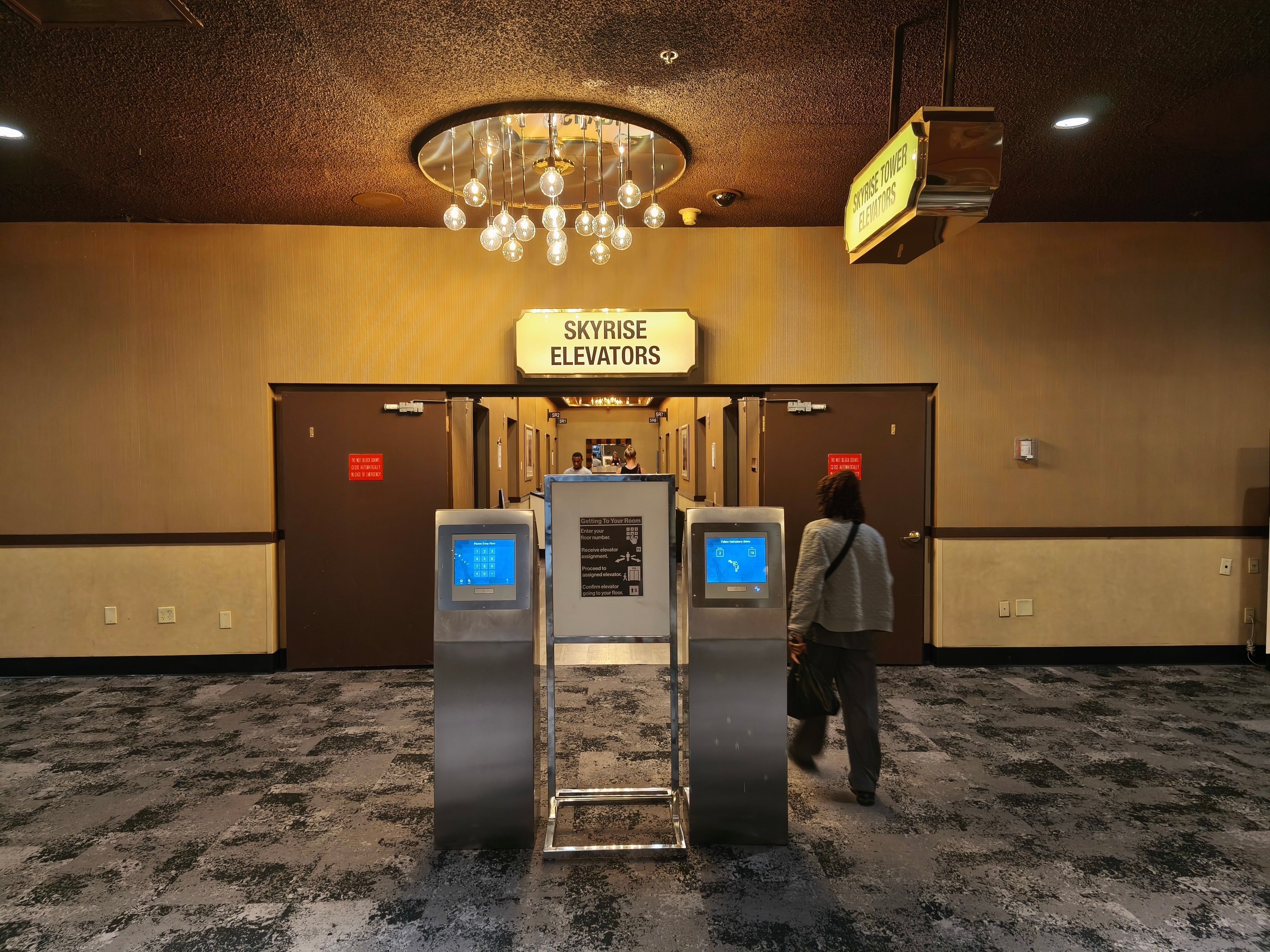
The elevator lobby.

The elevator situation at Circus Circus. Photographs from the scene.
There were six elevators for us at Circus Circus. There was a touchscreen: an elevator summoning terminal. You enter your floor number and the terminal tells you which elevator to take. This would be a reasonable system if the elevators functioned, if they stopped at the floors they were supposed to stop at, if the terminal's instructions bore any relationship to which elevator actually arrived. None of these conditions obtained. Some elevators did not work. Some did not stop at 14. The elevator terminal's suggestions were, at best, advisory.
We squeezed onto one. It had no buttons. It went to 15. We got out. There were no stairs down one floor, or none that we could find, and the geography of the 15th floor of Circus Circus at 11 at night is not a puzzle that exhausted people with children should be asked to solve. We got back in an elevator, went back down to the lobby, tried again.
The next elevator had buttons. Actual physical buttons, the technology of the previous century
The next one we got had buttons. Actual physical buttons, the technology of the previous century, reliable in the way that only very old things are reliable. It also had an operator — a Latino man in a smart uniform, standing with his hand on the door-close button and punching it with the languid rhythm of a man who has been here a long time and has made a considered peace with what that means. Not efficient. Nothing here was efficient. But he was present and deliberate and he had ironed his uniform and he punched that button with a dignity that the rest of the operation could not begin to claim.
We went up. We went back down one floor. We arrived at 14.

The floor of the elevators. Atmospheric, in its way.
Edd was not with us. Edd had been separated somewhere in the lobby, swallowed by the crowd or redirected by the screen or simply lost in the sheer improbability of the system. We went to the room. Five minutes later, Edd appeared. He did not explain how.
Some things in Las Vegas are better left unexplained.
Then we needed food and we needed beer and then we needed to be horizontal and unconscious: and only one of these three situations was available to us on the 14th floor of Circus Circus.
We needed food and we needed beer and then we needed to be horizontal and unconscious — and only one of these three situations was available to us on the 14th floor of Circus Circus
We took the stairs.
I should explain the stairs at Circus Circus. They are a service stairwell — bare concrete, functional lighting, the kind of infrastructure that exists to satisfy a fire code rather than to serve a human being. The signs directed us downward with the confidence of signage that has never been questioned. Edd led the way.
I was at the back. This requires explanation. There was a kidney stone fragment — or the remains of one, shattered months ago by ultrasound in a hospital that now felt like a feature of a previous life — making its way through my urinary tract, and it had chosen this day, this airport queue, this casino floor crossing, this elevator odyssey, to make itself known. I was moving strangely. Carefully. The way a man moves when his body has become a negotiation rather than a vehicle. The others reached the bottom of the stairs before me.
There was no exit.
The signs had directed us, with total institutional confidence, to a dead end. Not a blocked door. Not a locked exit. Nothing. Just concrete and the faint suggestion that whoever designed this had either never considered the possibility of a real emergency, or had considered it and decided it was someone else's problem.
Edd looked at it for a moment — the bare wall, the dead end, the nothing where the exit should have been — and said what it needed: that if people were really trying to escape something, if there was smoke or a stampede or the particular American terror of a gunshot in an enclosed space, and they came down here following the signs, they would arrive at this wall and they would have nowhere to go. Last March, a fight broke out in the Adventuredome — teenagers, a rumour of gunshots, none of it true, but the panic was real. Hundreds of people ran. The hotel was evacuated. People streamed out of Circus Circus in the particular terror that only an American crowd can generate, because in America the gunshot is never entirely hypothetical, never entirely a rumour, never quite safe to dismiss. Some of them, following the signs, would have come this way. To this wall.
We went back up two floors. There was an emergency exit to the street — the kind with a push-bar and a sign warning that an alarm would sound if we opened it. We went up two more floors and back into the room corridors, and after five minutes — which at this point in the evening felt like clemency — an elevator arrived and took us down to the lobby.
The Burger King in the lobby had ordering terminals. The terminals were broken. There is a particular species of Las Vegas hunger — the hunger of people who have crossed an ocean and a time zone and a casino floor twice with enormous cases and failed to reach their room through any conventional means — and it does not respond well to broken terminals. I left the queue.
Around the corner, deeper into the building, I found a pizza place operated on human principles — a counter, a person behind it, food visible and real. It was nearly closing. I called Stevie and told her to bring everyone. The party got slightly lost on the way but they made it.
The children had pizza and chips. The adults got beer, cold and American and exactly right. Then afterwards tequila and whiskey from a bar where the barman worked with furious flair — bottles tracing arcs through the air, caught without looking, placed without ceremony, the whole performance conducted with the ease of a man who has decided that if this is what his life is then he will be magnificent at it. The children could not approach the bar. We stood at a respectful distance and drank and watched him and it was, briefly, genuinely wonderful.
Stevie and Tim, somewhere between the check-in terminals and the tequila. Easter 2026.
Then we went to find the carousel. The famous rotating carousel. We found it above us.
The midway level of Circus Circus is the second floor — the place where the circus acts perform above the casino below, where the acrobats and the clowns do their work in the air over the heads of the gamblers, the whole original deranged premise of the hotel made flesh every hour. The Horse-A-Round sits up there. We could see the people on it, moving slowly, their faces turned toward the slot machines arranged in a ring on the rotating platform, the whole thing turning at the speed of a clock hand — perceptible only if you watched it for long enough. From below, you look up through the levels of this strange building and see them going round, these people on their slowly rotating platform, and it has the quality of something from a dream about America: people gambling, moving, going nowhere, watched from below by other people who are also going nowhere but at least have the honesty to be stationary about it.
The Horse-A-Round was where the literary mythology of this place was forged. A book was written about it. A film was made of the book. The film couldn't use the name Circus Circus because Circus Circus, rather magnificently, wanted nothing whatsoever to do with it — refused permission, refused the use of its name, refused to let the cameras on the premises. So the carousel was recreated on a film set, and in a detail that is either a deliberate joke or a beautiful accident, the recreation rotates in the opposite direction to the real one.
The real Horse-A-Round stopped serving alcohol in 2010. Converted to a gelato bar. Then a snack bar. By the time we stood below it at midnight with tequila warming our chests it had been a long time since anyone could get drunk up there, and there is an argument — not one I want to make, but it exists — that the conversion of the great literary bar of American excess into an ice cream stand for children is in fact the most perfectly appropriate ending the thing could have had, the joke completing itself. The horses still go round. The dream still goes round. It just serves churros now.
The horses still go round. The dream still goes round. It just serves churros now
The children stood and looked up at it. None of them had read the book. They looked at it the way children look at things that adults are finding significant for reasons they can't access yet. That was fine. They will read the book. Then they will understand what they were looking at.
Let's go, I said. We have to do the elevators again.
The elevator lobby at one in the morning had the quality of a country where the government has stopped pretending. The post-show crowd had thinned but what remained was somehow more concentrated in its exhaustion — people who had been waiting long enough to have passed through frustration and out the other side into a kind of acceptance. Among them, a couple: a father holding one child and feeding it from a bottle, a mother with another child asleep in a double buggy. They had a few words of English between them and Spanish for the rest. They were trying to get to the 25th floor.
We let them on first. This felt non-negotiable.
The elevator stopped at nearly every floor. This is the nature of the Circus Circus elevator after midnight — it is a local service, it has no interest in your urgency, it regards each floor as equally worthy of its attention. We rose through the building in increments, seven of us and the family and the babies and the buggy and the bottle, and at the 14th floor we stepped out and said goodbye in the way that people say goodbye when they have shared something too absurd to name. The family went on up, the father still feeding the child with the bottle, the mother with the sleeping one in the buggy, ascending toward the 25th floor of Circus Circus, Las Vegas, Easter 2026, the carousel still turning somewhere below them and the dream still doing whatever it is the dream does when nobody is watching.
The corridor was quiet. The room was clean — I want to be clear about this. Whatever Circus Circus had failed at structurally, the invisible army behind the scenes was still doing its work. The beds were made. The bathroom was old but had been cleaned as far as it could have been. Three hundred housekeeping staff, or 500, working their shifts while the elevators failed and the stairwells led nowhere and the check-in terminals broke and the ordering terminals at the Burger King broke and the elevator-summoning terminals in the elevator lobby directed you to elevators that didn't stop at your floor — all of it was held together, heroically, by the people you hardly see.
In the room, the air conditioning was naturally old. And loud. After a shower, the bath drained with a kind of lazy indifference. At the bottom of the toilet bowl there were scratches — long, pale scratches of the kind a blade makes on porcelain, not filth but something more considered, more deliberate, a mark left by someone who was here before us and had their own reasons.
I looked at them for a moment and decided not to think about it and went to bed.
I lay in the dark of the 14th floor and thought about the carousel turning and the father with the bottle and Edd at the bottom of the stairwell where there was no door, and the stone fragment making its way through me by its own slow schedule, and the beast that turns still.
The beast turns still.
A note from Stevie
This is Tim's account of Day 1 of our family Las Vegas road trip, Easter 2026 — and yes, every word of the elevator situation is true. Follow along for more dispatches from the road. In the meantime, if you'd like a piece of jewellery that travels as well as we (eventually) do, you'll find us at offthemapjewellery.com.