
Road Trip Diaries · Day 3
Las Vegas to the Grand Canyon, Easter 2026 · Leo, four hundred dollars, and a hole in the world

Written by Tim · Stevie's other half
Off The Map Jewellery family road trip · Easter 2026
Watch the ADVENTURE ▸ Day 3 Short
Before any of it — before Leo the driver and his people carrier and the Enterprise counter and the four hundred dollars and the ice at Whole Foods and the road and everything the road contained — there was the passport situation.
We were leaving Circus Circus. This should have been a simple operation. It was not. Somewhere in the process that morning of assembling seven people and their luggage in the corridor by the elevators — the elevators that had spent two days treating us as a philosophical problem rather than a logistical one — the passports could not be found. Not misplaced in the casual sense. Gone. The kind of gone that requires unpacking bags in an elevator lobby while a security guard watches from a distance with the expression of a man who has seen this many times before. Cases were opened. Bags were searched. The children stood to one side with patient resignation.
The passports were in the bag that had been checked first and declared clear. They are always in the bag that was checked first and declared clear. We repacked.
The security guard, who had not moved or spoken, gave a small nod as we wheeled the cases away, the nod of a man confirming a private theory about the human condition.
Leo was waiting.
Leo was from the south of Brazil, which is a different country from Brazil in the way that matters — gaucho country, the bottom of the continent, a place that produces a particular kind of man — and he was a grafter who bent the rules and had driven us from Harry Reid International to Circus Circus two days earlier with our enormous cases and our transatlantic stupor intact.
Now he was taking us back to Harry Reid to collect our rental cars from the Enterprise operation there.
We crammed into his people carrier — all seven of us, the accumulated luggage of a transatlantic Easter road trip, three children who had survived Circus Circus and the elevators and the dead end basement and the carousel bar and two nights of keeping the DND sign on the door because the invisible army that maintains a hotel of that scale deserves to be left alone when possible — and Leo drove us to the airport because this is what Leo did, and because Leo, being a man who bends the rules in the specific and productive way, had redistributed the passengers until everyone was technically present and my daughter, 12 years old, was sitting on my knee.
There is a maximum occupancy for a people carrier and Leo was acquainted with the number and had decided it was advisory.
On the short drive back to Harry Reid, my daughter said: I love you dadda.
I said: I love you too, sweetheart.
At the Enterprise counter we discovered that we had not factored in the insurance. The cars were $400 more than expected. This is the thing about America: it is always $400 more than expected. There is a line item you missed, a coverage you declined that turned out to be mandatory, a fee that exists in a category nobody mentioned during the booking process. We absorbed it because we were standing at a counter in an airport and the alternative was to not have the cars, and we needed the cars, because the Grand Canyon was 270 miles away and Leo, magnificent as he was, had other engagements.
This is the thing about America: it is always $400 more than expected. There is a line item you missed, a coverage you declined that turned out to be mandatory, a fee that exists in a category nobody mentioned during the booking process.
We got a Dodge Durango — a huge estate with the chassis of a truck and the potential to carry seven people when the seats in the boot were set up — and, eventually, a Ford Escape. Edd and Genea took their time choosing but settled on the Escape, and we loaded the luggage and the children into our respective vehicles and pointed them south.

On the way out of Vegas we stopped at a Whole Foods supermarket for supplies. This was the correct call strategically and a minor ordeal logistically, because a Whole Foods is, philosophically, a place designed to make you question every choice you have ever made about food and hence life itself. We also needed ice. The ice was nowhere. We traversed the store in expanding circles, checking every refrigerated section. It was only on the way out, past the cashiers, that we found it: bags of ice stacked in a chest freezer beside the exit, positioned with the casual confidence of something that has always been exactly where it should be and cannot understand why you are only finding it now.
Leaving, we discovered the Durango's brakes stopped the car the way a religious conviction stops an argument — completely, and with no interest in your prior momentum. We drove a circuit of the Whole Foods car park establishing the parameters of this relationship, and then joined the Strip heading south.
Vegas in the morning is a film set between shoots. The neon was still going, because it is always going. The pedestrians had thinned to the category of person who needs to be on the Las Vegas Strip at this particular hour. The Billboard Lawyers watched us go — Naqvi, Dimopoulos, Glen Lerner the Heavy Hitter, 50 feet of aggressive benevolence each — and then we were past them and the desert opened up and we hit 65 and stayed there.
On the I-15 south, heading out of Vegas toward the 93 junction, there was a fuel tanker on its side in the central reservation — lying across the median with the patient helplessness of something enormous that has given up trying. It had been there for some time. Hazmat crews were working on it. When a fuel tanker goes over it does not just spill: it seeps. The diesel goes into the ground and the ground holds it, and months later someone comes back with specialist equipment and digs up the earth to a depth of several feet and carts it away in sealed containers, because the desert that looks so clean from a car window is in fact a recording medium of the earth, and it keeps everything.
The Hoover Dam sits behind you as you head south on the 93, invisible but present the way that large facts are present even when you cannot see them. The road itself was born from the dam — paved in the late 1930s by the same construction consortium that had just finished rearranging the Colorado River, because a dam of that scale required connections to the outside world and the republic cannot build things without building the infrastructure to reach them.
The dam's construction killed 112 men officially. Unofficially more, because dying of heat — heat prostration, the reports called it — was not classified as an industrial accident. Dying of heat was something that happened to a man, not something that happened because of a management decision about shift length and water access in 120-degree temperatures. The distinction was important for the insurance.
The Tierney story is perhaps the most famous. John Gregory Tierney was a surveyor, part of the crew scouting the Colorado River in 1921 for the best location to put the dam. On December 20th of that year, he was working on a barge in the middle of the river when he was swept overboard and drowned. His body was never recovered. Exactly 14 years later, on December 20th, 1935, the last industrial fatality of the dam's construction was Patrick Tierney — John Gregory's only son — who fell 320 feet from an intake tower on the Arizona side and hit the water below. Father and son. Same date. Fourteen years apart.
The desert that looks so clean from a car window is in fact a recording medium of the earth, and it keeps everything.
The road runs south from all of this. We ran south with it.
About 30 miles south of the Hoover Dam, on the left, there was a community of single storey buildings.
I use the word "building" loosely. What there was, more precisely, was a series of structures arranged across a flat piece of desert in the way that objects arrange themselves when nobody has been given authority to tell them where to go. Tin roofs. Corrugated metal thrown over RVs to give the desert sun something to fight with other than the vehicle underneath. Solar panels on every available surface, tilted toward the Nevada light with the devotion of converts. Large plastic cubes in the yards — white and black and pale green — which announced, to anyone who knew what they were looking at, that there were no pipes out here. No city water. No grid, or very little of it. Every drop of water that went into those houses had been driven in on a trailer from a filling station in Dolan Springs or Kingman, pumped into one of these tanks, and rationed with the discipline of people who understand scarcity in a way that has never once crossed the mind of anyone standing in a Las Vegas hotel shower.
This was a community that had looked at the desert wind and the desert heat and the economics of second storeys and had said: no. Everything one storey. Everything low to the ground. Everything, from the RV to the modified shipping container to the thing that had started as a mobile home, pressed down into the earth as though trying to avoid being noticed by whatever forces had made this place so hostile to comfort. The median age here is around 61. A lot of them veterans. A lot of them retirees on fixed incomes who do not want stairs and little much else. They want a flat, manageable piece of desert where nobody tells them what to do, and they have, by this measure, succeeded.
This was White Hills, Arizona. Population 345 at the last census, which was conducted, one imagines, by someone who drove out here in a government vehicle and spent most of the day wondering if anyone was actually home or if the various structures were simply maintaining themselves out of habit. It had been a silver mining town in the 1890s — 15 mines working within a single mile, a stamp mill, a full complement of saloons. The silver ran out and the people left and then, a century later, different people arrived. The ones priced out of Las Vegas. The ones retired on incomes the city could no longer contain. The ones who had made a decision about property taxes and HOAs and the general project of being told what to do. They bought an acre for the price of two months' rent in Henderson and they hauled their water and they ran their generators and some of them drove 70 miles north to the Strip five days a week for work because it was cheaper than living there.
We passed it at 65 miles an hour. You do not stop at White Hills.
The first road gator appeared not long after.
This is what they call them — road gators — the great shredded loops of truck tyre that accumulate on the hard shoulder of American interstates the way sediment accumulates at the bottom of a river. They lie there in the sun, curling and baking, looking like the shed skins of something vast and industrial. Every few hundred metres, another one. Then a cluster of them. Then a long straight stretch of nothing and then three more, as though the road itself were moulting.
The mechanism is this: a semi-truck has 18 wheels not because the laws of physics require it but because redundancy is the only sensible response to the mathematics of failure. Each of those trucks runs on retreads — new tread glued onto old casings, because this is cheaper than new tyres. As the truck grinds up a sustained high-altitude climb in desert heat, the glue fails. The tread peels from the casing the way an orange skin separates from the fruit, except the orange skin weighs 50 pounds and is moving at 70 miles an hour and contains steel belting that will go through a brake line like a wire through warm cheese, and the flailing end of it can take off a bumper or destroy a wheel arch or, if it catches the underside of the car at the wrong angle, puncture a fuel tank and leave you standing in the desert with your luggage and your children and a growing sense that this was not in the brochure.
The driver feels a vibration. Checks the mirror. Sees the gator fly. Keeps rolling, because he has 17 other wheels and a schedule.
The gator stays behind. It bakes. It becomes part of the landscape. Most of them do not represent accidents. The truck rolls on. But some of them — the ones that came off when a car was close behind, the ones that went through a windscreen or under a chassis — those are a different kind of gator. The road does not label them differently. They all look the same, lying there in the sun.

The Cerbat Mountains came up on the right as we approached Kingman — great flat-topped volcanic mesas, the horizontal lava flows banded like geological filing, the faces split into vertical columns by the jointing that forms when thick basalt cools and shrinks and cracks with mathematical precision. The harder cap survives while the rock beneath erodes away, and you get these fortress walls standing over the desert floor with the composed authority of things that have seen the surrounding landscape come and go many times.
We pulled off the highway at the TA truck stop on the western edge of Kingman, where the 93 meets the I-40, and went into the Black Bear Diner.
The Black Bear Diner is a chain, but a chain of the useful American kind — weatherproofed by decades of actual use, bearing the marks of a million transient meals, decorated with bears in a way that stops just short of being too many bears.
Genea bought two bags of deep-fried pickles, which were better than they had a right to be. We ate outside, at the picnic tables, in the full knowledge that we were prolonging the stop but unable to justify hurrying away from the specific pleasure of watching 18-wheelers manoeuvre with the ponderous deliberation of very large animals negotiating a tight space. The truckers cleaned their windscreens in the wind. Bugs and road dust and the residue of hundreds of miles of desert, wiped off with unhurried efficiency.
One of the children had got a can of Mountain Dew — 20 fluid ounces, 77 grams of added sugar, 154% of your recommended daily value, the number printed on the label with the brazen cheerfulness of something that has decided transparency is its own kind of defence. Nineteen teaspoons. In a bottle you can finish in the cab of your truck in four minutes.
Roughly 70% of long-haul truck drivers in the United States are classified as obese, and they suffer from diabetes at a rate 50% higher than the general population, and watching the men in the car park and looking at the number on the bottle these two facts arranged themselves into something that felt less like a coincidence and more like a policy.
Genea said: ordinary Americans didn't want any of this. They don't want to be the bullies of the world. But after Bretton Woods the dollar became the world's reserve currency and that changed something in the nature of what the government could do and what it decided to do with that, and here we are, she said, and gestured at the bottle, and at the car park, and at the general situation.
We sat with this for a moment in the desert wind.

Moving through Kingman toward the I-40 east on-ramp, two signs in quick succession.
Medusa Farms weed dispensary: locally owned, community-minded, five dollar grams, $120 ounces all day every day, free pre-rolled hooters — large joints — for veterans, seniors, and teachers on every visit, grown and packaged in their own 5,000 square-foot facility in Kingman with what South Park would call Tegridy. My son, 11 years old and in possession of a comprehensive South Park education that we have permitted with the resigned acceptance of parents who recognised a losing battle early, identified the reference immediately and was pleased. He has seen Christian Rock Hard. That's the episode where Cartman tells Token — the only Black kid in South Park — that he must have a bass guitar in his basement and must be able to play it, because he is Black.
Immediately adjacent to the Medusa Farms sign: all your ammo and gun needs.
This is the holy trinity of the Nevada-Arizona border. Weed. Guns. And the lawyers on their billboards miles back who are ready to deal with the consequences. The legal paradox is precise: in Arizona, you can walk out of Medusa Farms with a legally purchased product and walk into the gun shop next door and legally purchase a firearm. Under federal law, it is illegal to possess a firearm if you are a marijuana user. Nobody enforces this. The signs are next to each other because in this part of the desert the concept of personal liberty has been interpreted to include the right to get stoned, shoot things, crash your car, and call the Heavy Hitter from the roadside, and the law has arranged itself, with the weary pragmatism of something that has been ignored long enough, into rough compliance with the arrangement.
On the I-40 east out of Kingman, climbing the long grade toward the high plateau, my son called for Hot Fuss by The Killers — the whole family knew the album, and my son had caught one of the tracks on the in-flight entertainment on the way over and had been thinking about it ever since. For some time before I had spent a considerable portion of the drive telling Apple Music to play Hallo Gallo by NEU! — shouting it slowly, shouting it fast, trying different emphases, attempting a more phonetic approach, wondering aloud whether the problem was the umlaut — and getting Will Smith every single time. Not approximately Will Smith. Not something in the general sonic vicinity of NEU!. Will Smith.
Hot Fuss opened. The road opened. The trucks in the right lane settled into their grinding ascent and Brandon Flowers began singing in his fake British accent about being a victim of an unnamed woman's infidelity, and the thing that struck you, sitting in a large American car climbing out of the desert that had produced the man, was that he wrote these songs in Las Vegas. He was a bellboy at the Gold Coast Casino — broke, weird-haired, spending his tips on synthesisers, working the graveyard shift and rushing home afterward with 20 minutes to get to a keyboard before whatever melody had been building in his head all day evaporated.
The woman who is not named in Mr Brightside has spent 23 years being not named in one of the most streamed songs in human history — a song that plays in supermarkets and at weddings and emanates from car windows on every continent. She is statistically almost certain to encounter it several times a week.
The woman who is not named in Mr Brightside has spent 23 years being not named in one of the most streamed songs in human history — a song that plays in supermarkets and at weddings and emanates from car windows on every continent. She is statistically almost certain to encounter it several times a week.
Another cluster of road gators on the shoulder as the grade steepened.
Blake Ranch at Exit 66: an RV park and legitimate horse motel, because people haul horses across America in long trailers and the horses need somewhere to stop, and someone here identified this need and met it without sentiment.
All These Things That I've Done came on with its famous refrain. The British comedian Bill Bailey has observed that I've got soul but I'm not a soldier makes about as much sense as I've got ham but I'm not a hamster. This is correct. These two things coexist without difficulty, which is one of the comforting things about art.
Seligman appeared from the interstate as a handful of sun-bleached buildings and the radar dome on a nearby hilltop — white, geodesic, part of the Joint Surveillance System, built during the Cold War to spot Soviet bombers and repurposed now to ensure Southwest Airlines flights don't clip private Cessnas over the Coconino Plateau. The real Seligman is tucked just off the main road on the old Route 66 business loop: one street of 1950s diners and fibreglass statues of Elvis, a town bypassed by the I-40 in 1984 and packaging its own nostalgia ever since. Angel Delgadillo, the local barber, lobbied the state to designate Route 66 a Historic Highway, which is the only reason it exists now as a tourist attraction rather than a footnote to a bypass.
Seligman was the inspiration for Radiator Springs in the Pixar film Cars. My son had the Lightning McQueen lego when he was small. He watched Mater's Tall Tales — when I'm tow-mater and I don't got a last name, when I'm lyin', I'm dyin' — but he is now 11 and has moved on to South Park and a more sophisticated understanding of the world, which is, when you think about it, exactly what Mater's Tall Tales was training him for all along.
We crossed the bridge. Below, the neon of the Route 66 motels looked like a film set dropped into the middle of a vast, indifferent valley. Then it was gone and I asked Apple Music for Steve Earle and got Steve Earle and Six Days on the Road came on, which felt like a small victory after the Will Smith situation — Dave Dudley's song in Earle's version, which is the gold standard. Well it seems like a month since I kissed my baby goodbye. The trucks in the right lane were still grinding upward and the road was doing the thing the song was singing about and for a moment the gap between the song and the world it described collapsed completely and we were inside both simultaneously, which is when music is doing what it is supposed to do.
Ash Fork: the big yellow cylinders of the Transwestern Pipeline compressor station, high-pressure natural gas storage tanks, part of the artery that carries gas from the Permian Basin in Texas all the way to California, boosted here because gas loses pressure over distance. If one of those tanks failed, it would make the tanker in the median look like a minor inconvenience.
Ash Fork is the Flagstone Capital of the World. The pink and red volcanic stone used in high-end American patios comes out of the ground here and is shipped to people who will never come within 300 miles of this place. The town exists to extract and move. Between the gas and the stone and the railroad that preceded both, Ash Fork has been an industrial utility town for its entire existence, and the landscape around it shows the marks.
The Purple Heart Trail signs appearing now — the I-40 across Arizona designated a memorial to American military dead and wounded. The road built in the postwar years, authorised by Eisenhower in 1956, officially the National System of Interstate and Defense Highways — Defense, always Defense, built to move missiles and evacuate cities, a Cold War logistics network dressed in the language of commerce and convenience — laid over an older road, and before that a wagon track, and before that a railroad right of way, and before that the paths that the people who lived here first had worn into the ground over centuries. The logic of the road does not change. The destination does. The same infrastructure that was built to fight one war is now being used to supply another, in a different desert, against a different people, and the ordinary Americans who built it and maintain it and the British tourists who drive their rental Durangos along it had no more say in that decision than the Hualapai had in the building of the road itself.
The Hualapai lived in the area between the Grand Canyon and the Bill Williams River. When the gold rush came in 1863 and the miners and ranchers followed, they fought for five years between 1865 and 1870 to protect their water holes — their actual water holes, the specific springs that made survival in this desert possible. They lost. They were force-marched in 1874 to what the officer in charge called the Sahara of the Colorado, where disease and starvation killed many of those who arrived, and from which they eventually escaped back to their own land only to find it occupied by ranchers who had no intention of leaving.
They were given a reservation in 1883. One million acres, described in the documents as poor land, because the good parts had been allocated to other purposes.
The old mechanical windmills appeared on the sides of the road as we climbed — not the modern energy kind but the originals, Aeromotor-design, the same basic mechanism since 1888: thin metal blades catching whatever desert breeze was available and converting it through a simple gearbox into an up-and-down motion that drove a piston down into the water table, pumping a few cups at a time into a stock tank for the cattle. They have been doing this since before the interstate existed, standing in the desert with the patient self-sufficiency of something that has never needed to be improved, turning in the wind, pulling water from the rock.
The old mechanical windmills appeared on the sides of the road as we climbed — not the modern energy kind but the originals, Aeromotor-design, the same basic mechanism since 1888.
We turned north at Williams on Highway 64, and the road changed.
The I-40 is a manifesto. The 64 north is something else. The Kaibab National Forest comes in on both sides, and the Ponderosas — tall, straight, vanilla-scented, eighty feet high — crowd the road with the composed attention of something that has been here considerably longer than the asphalt and is aware of this fact. You cross a line and the desert is gone and this is forest, and the air coming through the vents is clean in a way that makes everything south of Williams retroactively comprehensible as a different country.
The Red Hill Cinder Pit appeared at Spring Valley, on the left — a volcanic cinder cone being systematically dismantled for Pozzolan: volcanic ash mixed into cement because the Romans used it for the Pantheon, because the Romans knew things about permanence that we have mostly forgotten. The mountain being taken apart to make more road. The landscape metabolising itself through the mechanism of its own erasure.
My daughter shouted "Hot Chip!" at Apple Music and Apple Music, for once, complied without creative reinterpretation. We did not discuss it.
The sun was beginning its descent. Not dramatically, not yet, but with the considered intention of something that has a schedule and intends to keep it. Stevie had been watching it for the last hour without saying much. She had wanted to see the Grand Canyon at sunset since before this trip was a trip. There was still time. Possibly.
And then, in the distance to the right, Red Butte.
The surrounding plateau is vast and flat and covered in the Kaibab Forest, and Red Butte rises out of it — 800 feet of red sandstone capped in basalt, the basalt having protected what was underneath while everything around it eroded away over millions of years, the whole structure a geological survivor, a remnant of an older surface that got lucky. It looks intentional. It looks like it was placed. It looks like a monument, which is, as it turns out, exactly what it is.
The Havasupai call it Wii'i Gdwiisa. The clenched fist mountain. It is the place where their people emerged into the world. Their birthplace, their spiritual centre, the axis around which their understanding of this landscape organised itself for centuries before anyone else arrived to reorganise it. In summer, the Havasupai lived and farmed in the inner canyon, down in the blue-green water that gives them their name — the people of the blue-green waters. In winter, they came up to the plateau, to the forest around Red Butte, to hunt and gather and conduct the ceremonies that connected them to the land and to each other.
President Chester Arthur signed an executive order in 1882 that declared the plateau public land and confined the Havasupai to 518 acres in Cataract Canyon. According to the historical record, they were completely unaware of the executive order for several years. The silver rush and the railroad had arrived. The cattlemen claimed the springs. A Havasupai man named Waluthma was arrested in 1914 on suspicion of poaching a calf while crossing the plateau on his way home from Seligman — Seligman, where we had just crossed the bridge over the neon and the fibreglass Elvis and the Radiator Springs dream, 40 minutes south. A posse took Waluthma. By the time other Havasupai came for him he was dead — castrated, buried with chicken feathers on his head and red zigzag lines painted on his face.
This is what defending a water hole looked like in practice in 1914, on the land that the Purple Heart Trail now runs across.
When Grand Canyon National Park was created in 1919 the reservation was completely surrounded by park land. The Havasupai continued to cross the plateau seasonally, as they always had, dodging rangers. They were removed. They returned. A Havasupai woman named Mary Wescogame, in a deposition to the Indian Claims Commission, said: The Havasupai people want to get back here to the country they thought belonged to them. They were driven out, but they kept coming back.
In 1942, a National Park Service report co-authored by Frederick Law Olmsted Jr. argued against returning any land to the Havasupai. The park must be pristine, the logic went — meaning without evidence of habitation, meaning without the people who had been there longest, because their presence was, by the definitions then in use, incompatible with the concept of untouched nature. The Havasupai councilwoman Ophelia Watahomigie-Corliss said, decades later: The creation of Grand Canyon National Park was actually some of the darkest days for the Havasupai people. We lost a large area of our migration.
In 1975, Congress returned 185,000 acres of plateau land to the tribe. After 93 years, a portion.
There is a uranium mine five miles from Red Butte: the Canyon Mine. The Havasupai have been fighting this since the 1980s. The mine threatens the groundwater that feeds the springs and the Colorado River, which is their only water source.
I looked at Red Butte through the car window as it grew larger against the cloud-heavy sky and thought: no wonder it's holy.
Not they thought it was holy. It is holy. The distinction matters but it was weighed against a mining permit and found, in the calculus of the modern state, to be of lower value. And yet it is holy in the way that the places where people have been rooted to the earth for centuries are holy — which is not a supernatural claim but a claim about time and loss and what is destroyed when those things are taken.
The road we were driving was built over their winter camps. The town five minutes ahead, where we were going to sleep, stands on the land where they gathered each autumn before descending into the canyon.
Red Butte was on the right and grew.

Then Valle: RVs everywhere on the right, permanent dwellings, snow roofs over vehicles, the same basic arithmetic as White Hills four hours and a geological age behind us. Park workers living here because housing inside the park doesn't exist at a price that makes sense. A vintage propeller aircraft from the Planes of Fame annex sat by the road looking like it had landed yesterday, preserved perfectly by the dry, high, cold air that archives everything indefinitely without being asked.
Wild horses on the left, in the trees, standing with the particular stillness of animals that have decided the forest is theirs and are prepared to outlast the question. The Kaibab Wild Horses — feral descendants of Spanish stock, several hundred years adapted to this plateau. The Forest Service wants them gone. Others want them to stay. The horses continue to exist.
Country and Western's Reincarnation on the stereo — skeletal, desert-gothic, music that sounds like it was recorded at three in the morning in a house with too many rooms. The horses watched us pass through the darkening pines and did not move.
Now Tusayan: the IMAX, the Wendy's, the speed limit dropping from 65 to 35. Stevie put on Fake Empire by The National. A song about walking on tiptoe through a crumbling reality while maintaining the posture of normalcy, the piano stating its facts. Matt Berninger's voice carrying the weight of a man who has looked at the empire and understood both its grandeur and its fraudulence.
A sign: Low Flying Aircraft.
To the left, the helicopter fleet parked in rows — Maverick, AirStar, grounded for the evening, waiting for tomorrow's payload of tourists who will pay $300 to hover over the silence that the Havasupai fought for and lost and are still fighting for.
A dead cow by the roadside. Open Range in Arizona means the driver is responsible for the livestock, not the rancher. The cow had not understood this arrangement, which is not a legal defence available to cows. The modern state kept rolling past.
We went through the gate.
The Grand Canyon Hotel and Suites, Tusayan. Three storeys. A working elevator. After Circus Circus this felt like a statement about what hotels could be if they applied themselves. We dropped the bags at 18:00. The sun was lower than we wanted it to be.
There was a brief and efficient reconfiguration of the Durango — third row of seats set up, all seven of us loaded in, the logic being that we would pay the park entrance fee once for one vehicle rather than twice, because this trip had been costing us $400 at every turn and the canyon was not going to get another one. At the entrance station we discovered the fee structure had changed since January. Non-US residents now paid $100 each on top of the vehicle fee, which at seven people in a single car was a number that rearranged itself in the mind several times before settling. The annual non-resident pass was $250 and covered the vehicle and everyone in it for a year, across every affected park. We were going to Bryce. We were going to Zion. The arithmetic was not complicated.
We bought the pass at a machine by the gate, a paper ticket, filed it in the glovebox, and drove north toward the rim with the specific satisfaction of people who have, for once in this trip, extracted value from a transaction rather than the other way around.
It would not be the last time the pass paid for itself. It would also, as it turned out, not cover everything.
The road from Tusayan to the South Rim is 10 miles. It is also, if you are stuck behind a Class A motorhome driven by someone for whom the concept of urgency does not apply, approximately 40 minutes. The motorhome occupied the road with the serenity of something that has no particular relationship with time. It moved through the Kaibab Forest at a pace that suggested it was considering stopping to appreciate the trees. We followed it with the courtesy of people who understood that honking at a retirement vehicle on the road to the Grand Canyon was not the note on which to arrive at one of the great natural wonders of the world.
The sun continued its descent. The trees thinned. The entrance station was navigated. The visitor centre car park materialised and we were in it and out of the car before the doors had quite finished opening, moving at the specific pace of people who are not running but are also not walking, through the car park and along the path and through the last of the trees and then —
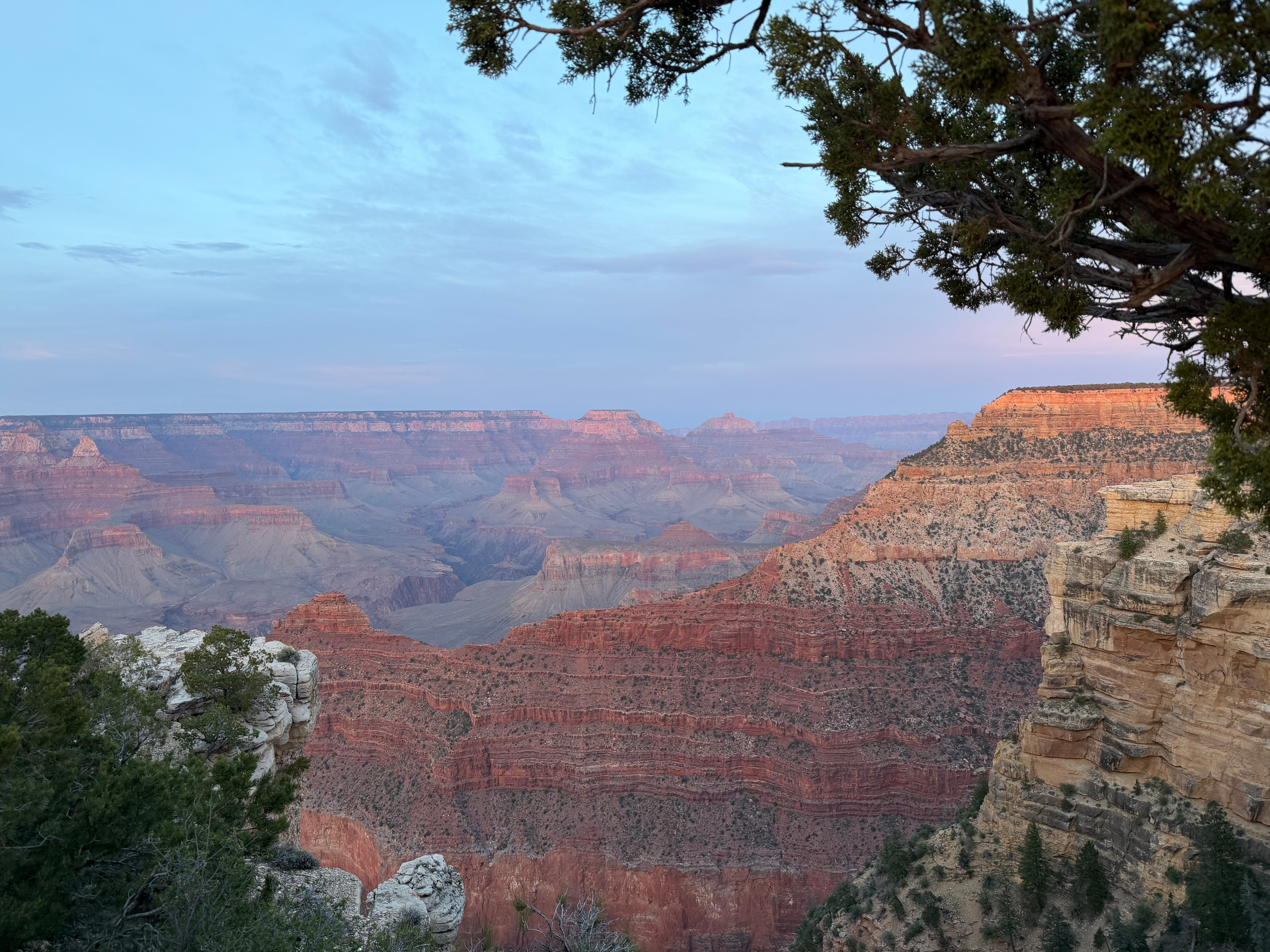
You are walking through Ponderosa forest and then you are not. There is a hole in the world in front of you a mile deep and 10 miles wide, made by water over six million years, and the light of a March sunset is doing things to the colours of the rock that the word red does not begin to address. Crimson. Ochre. Amber. Purple in the deep shadows of the inner gorge where the Colorado moves, invisible from up here, 278 miles of it threading through the bottom of something so large that the human visual system cannot process it as a single object and keeps trying to break it into comprehensible parts and failing.
We stood at the rim as the sun went down. The colours in the canyon shifted through registers that have no names in common use, deepening into something ancient and private, the rock returning to itself as the tourist light left it. The Colorado remained invisible at the bottom.
Venus appeared, low and bright in the southwest, glowing steadily in the cooling sky rather than twinkling — close enough to present a disc, the atmospheric interference averaged out and smoothed. Four and a half billion years in this sky. The canyon forming for six million of them. Us at the rim for 40 minutes, and already unable to leave.

The car park was dark by the time we got back to it.
Most of us were in the car. Edd and his daughter were not. We waited. We checked phones. His phone rang out. We got out of the car and called their names into the dark in the way you call names when you are not quite worried enough to be properly alarmed but sufficiently worried to feel slightly foolish about standing in a car park shouting into a forest. The Kaibab National Forest at night has the quality of a place that is quietly amused by this sort of thing. The trees did not help.
They materialised eventually from a direction that didn't quite correspond to any known path, in the manner of people who have had an unplanned adventure and are electing to present it as a slightly extended walk. We got in the car and drove the 10 miles back to Tusayan behind a different motorhome, which moved at the same pace as the first one, because this is the only speed available on this road after dark.
Back at the hotel: rum. The discovery that the hotel had a pool. My son's face when he discovered this was the face of someone whose evening had just been resolved. He went, came back soon, and reported on his return that it was tiny.
Everything is tiny after the Grand Canyon. The pool. The hotel. The road. The day. The whole human enterprise, briefly and usefully, returned to its correct proportions.

We drank rum and talked about what we had seen until the talking ran out, which took longer than usual.
A note from Stevie
"To say it was good to be back here after so many years was an understatement. In my mind I'm already planning the next visit, so much more of Arizona to see. In the meantime, if you'd like a piece of jewellery that travels as well as we do, you'll find us at offthemapjewellery.com."